
Pranos Fusion plots path from test tokamak to net gain
3 October 2026
Pranos Fusion has built India’s first privately developed tokamak and plans to run first plasma on it in January 2027. The Bengaluru company unveiled, PRAGYA, early last month at the Jawaharlal Nehru Centre for Advanced Scientific Research (JNCASR). FusionX spoke with Shaurya Kaushal, co-founder and CEO of Pranos Fusion, about what the machine has shown so far, the bigger machine it leads to and how the company plans to fund it.
India has run fusion research through the state Institute for Plasma Research (IPR) for decades and operates two tokamaks, Aditya-U and the Steady-State Superconducting Tokamak-1 (SST-1). PRAGYA is the first built by a private company. Kaushal went further, describing it as “maybe even the first private tokamak in Asia outside China”.
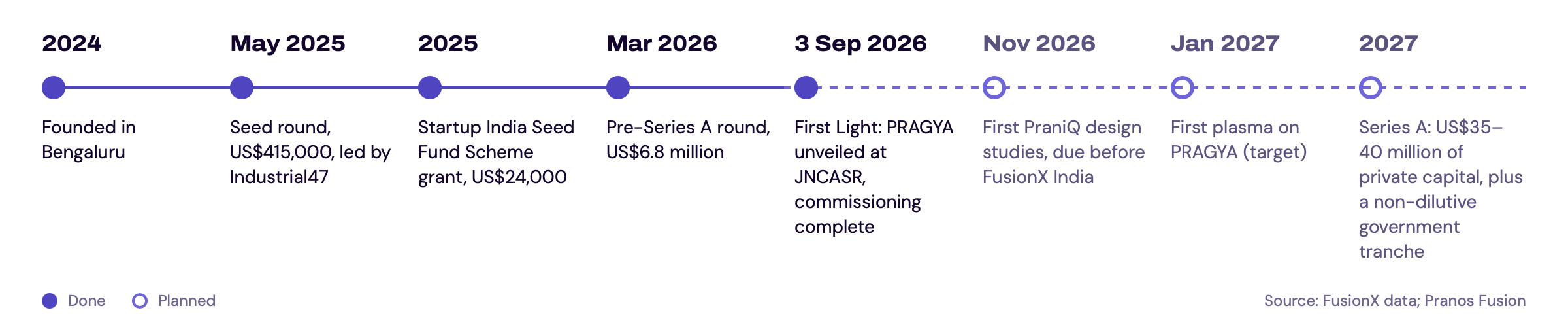
At the unveiling, Kaushal said PRAGYA had achieved ‘first light’: the vacuum vessel had been installed and leak-tested and the machine was running helium and argon discharges to condition its walls. Plasma is the next step “The pulsed TF power supply is on order and we’re targeting first plasma in Jan 2027,” Kaushal said.
A testbed for the next machine
PRAGYA is small by design and will not produce fusion. It is a compact, low-aspect-ratio tokamak with copper magnets, a 0.40 m major radius, a 0.1 tesla toroidal field and a target plasma current of 20–25 kA. Pranos aims to run 3,000 shots a year on it. Its main job is to run plasma experiments and test JENGA, the company’s design and control software, on real hardware rather than only in simulation. Pranos says the data will help it check design assumptions, improve plasma control and find engineering problems before it builds at scale.
The machine is one of three parts of what Pranos calls its integrated fusion stack. JENGA is meant to grow from modelling and simulation into monitoring and control, and Kaushal said a national lab is now using it as a design platform. MAGGA (MAGnetic GAin) is the company’s programme to make high-temperature superconducting (HTS) magnets in India. Pranos has an HTS winding line and is building a facility for HTS tape testing, characterisation and coil winding. Its first in-house REBCO coil is still being wound.
The company plans to keep the core tokamak, control software and magnets in-house and leave downstream systems to specialist partners. All three parts point at one bigger machine. “There’s no intermediate machine. PRAGYA feeds PraniQ directly,” Kaushal said.
PraniQ is an HTS tokamak designed for net scientific gain (Q > 1). It is being designed in JENGA, and Pranos plans to publish its first design studies before the end of 2026. The company’s stated sequence then runs through deuterium operations to a measurable deuterium-deuterium (D-D) neutron result within about two operating years.
Capital and cost
Pranos has raised some $7.2m to date, almost all of it equity. Industrial47 led a $415,000 (₹3.5 crore) Seed round that closed in May 2025, adding to the received ₹20 lakh ($24,000) the company from the Government of India’s Startup India Seed Fund Scheme (SISFS) the same year. On 1 March 2026 Pranos closed a $6.8 million (₹63 crore) pre-Series A round with pi Ventures, Ankur Capital, Industrial47 and Bhukhanwala Industries. Those funds, Kaushal said, will carry PRAGYA through first plasma and HTS integration.
PraniQ will need more and Pranos plans to open a Series A soon. Kaushal said the company has “a lot of inbound interest”. and is aiming for $35-40 million of private capital alongside a non-dilutive government tranche. It has applied for those funds under India’s RDIF scheme and sees the Nuclear Energy Mission as a second channel. Those funds would carry PraniQ to design freeze, the point at which the design is fixed, and pay for long lead-time components. It would also fund a coil and cable facility to scale up MAGGA, and a permanent site.
The company’s case to investors rests on cost. Kaushal said PRAGYA went from design to machine in about 10 months, and gave three reasons the company has got this far on its current funding. The first is India’s cost base. Vessel fabrication, structures, power electronics, civil works and engineering talent “come in at a fraction of US/UK cost”, he said, putting the gap at 5–10 times on those parts. The gap narrows across a whole machine, because HTS tape, RF sources and some diagnostics are imported and priced in dollars. “It isn’t uniform, and we don’t pretend it is,” Kaushal said, putting the overall figure at closer to 2–3 times. The second is use of national facilities. Pranos works through partner campuses and Department of Atomic Energy (DAE) and IPR test sites rather than building everything itself. The third, Kaushal said, is the company’s ability to leverage “India’s technical know-how from ITER”.
Pace and progress
By the company’s own account, funding, not engineering, now sets its pace. “Our schedule is set by how fast we can fund HTS tape, RF heating and pulsed power, not by engineering throughput,” Kaushal said. “Milestone-gated raises, government co-funding and early revenue from JENGA and MAGGA are how we manage it.” The other risk he named is regulation. Pranos will need to work through the Atomic Energy Regulatory Board (AERB) route for deuterium and, later, tritium operation, which Kaushal said the company is “starting early rather than late”.
So far, Pranos has built a tokamak and shown that its vessel holds vacuum and that it can run wall-conditioning discharges. It has not yet made plasma, finished its first HTS coil nor published a PraniQ design. But design studies are due in November and first plasma on PRAGYA in January 2027. And, beyond those, the company’s own account is clear: speed to net-gain machine depends on how fast it can raise the money.
Fusion approach: Magnetic Confinement, Tokamak
Country/Region: India
Tags: JENGA, MAGGA, PRAGYA, PraniQ, Pranos Fusion