
In Conversation: Will Regan, Pacific Fusion
26 March 2025
That >$900m Series A and the path commercialisation

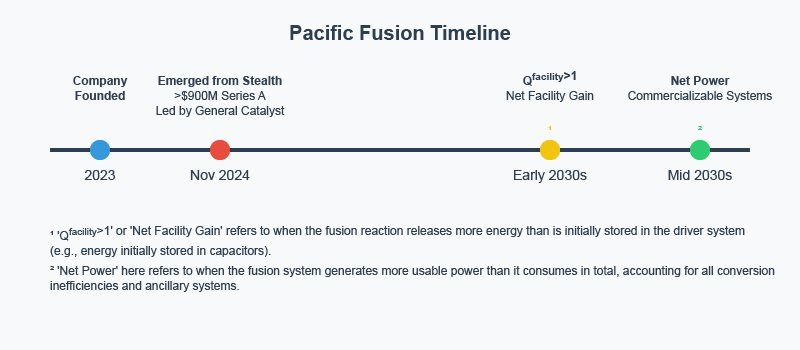
Founded in 2023, Pacific Fusion emerged from stealth in November 2024 with the industry’s largest-ever Series A, with more than $900 million committed, led by General Catalyst.
The company focuses on a pulsed magnetic path to inertial fusion using fast-rising, high-current pulses to magnetically squeeze and heat small containers of deuterium-tritium fuel, driving the fuel to fusion conditions.
The company is building a ‘fast pulser’, similar to Sandia’s Z Machine but made more efficient and compact by leveraging advances in pulsed power engineering, especially the impedance-matched Marx generator (IMG) first demonstrated at Lawrence Livermore National Laboratory in 2022.
Last month, FusionX sat down for a long chat with Will Regan, Founder & President of Pacific Fusion to explore the company’s approach to fusion, the path to commercialisation, and that headline-grabbing, milestone-based financing.
FusionX: Pacific Fusion aims to achieve net gain with a high-gain pulsed magnetic fusion driver. Can you briefly explain what makes this approach unique, and arguably superior to other fusion concepts?
Will Regan: There’s many, many ways to do fusion, from magnetic to inertial and many things in between and they all come with different advantages and challenges. What we’re fortunate to build on is an approach that has a combination of a strong science basis, uses proven engineering, and has a very nice economic path to making low-cost firm-power.
On the science front, we build on the legacy of decades and decades of hard work at the National Ignition Facility at Lawrence Livermore National Laboratory and the Z Machine at Sandia National Laboratories. On the engineering front, we can access that proven science with decades of engineering know-how in pulsed power. And also some very recent advances in very efficient pulsed power architecture – that our CTO, Keith LeChien was one of the co-inventors of – known as impedance-matched Marx generators.

On the economic front, we have some nice supply chain advantages. Our system is built from a few components, made from common materials. We have a lot of geometric advantages: the chambers are largely cylindrical, which facilitates O&M. Our targets themselves are largely cylindrical, which facilitates easy fabrication and low effective fuel cost.
FusionX: So what’s the key risk that you face on that path to commercialization and when do you expect to retire it?
Will: I can’t really identify a single existential threat. We’re fortunate to build on decades and decades of scientific and engineering advances. So it’s really the system integration and very good execution of that.
Of course, there’s still scientific challenges in scaling up what the Z-machine and the NIF have done into a regime where you’re releasing net energy. But it’s really lots of integration of those proven components.
FusionX: You referenced NIF, so why this path and not a more conventional laser driven ICF approach?
Will: To be fair, NIF was not built as a power plant. NIF was the research facility designed to get ignition1 and it succeeded wildly at that. So it’s a little apples to oranges, but I will say, our approach is inherently very efficient.
Whereas NIF right now converts about 0.7% of its stored energy into laser light, and a fraction of that gets into the internal energy of the fuel. We can deliver around, or even more than, 10% of the stored energy to our target area, and then couple a lot of that into the fuel internal energy. So, with a smaller facility and lower cost, we can get more energy into the fuel and drive higher gains. That means that, because we’re more efficient, we have a shallower hole to dig out of as we try to get to net energy output.
FusionX: Talk us through the timeline, from now to Q>12 Give us some feel for the time scales and the key challenges and milestones along them.
Will: We’re aiming, by early 2030s, to demonstrate net facility gain3 and in parallel with that to eliminate a lot of the significant hurdles to building commercial power plants. That means we both need to build a system that in single shots, gets more fusion energy out than is stored in the system, and also to look at how to take that once-a-day system and fire it repeatedly and reliably for long system lifetimes.
We have to build the system. Our system’s made from about 150 modules. Modules are about the size of a shipping container. We’re currently looking at sites around the area to build that facility.
FusionX: And from then to a commercially-viable power plant?
Will: We’re aiming for a few years after that achievement of net facility gain to achieve net power4. There’s obviously work to do in turning that first of a kind demonstration into a pilot plant. But we aim to do as much prep work and pull as much as we can forward so that there’s only a few years separating those two things. We are already doing development of capacitors and switches that last considerably longer but cost about the same or a little bit less, working on solutions to maintain the chamber, etc….
FusionX: So net power sometime mid 2030s?
Will: Yes
FusionX: A $900 million Series A, that’s the largest series A in the fusion industry by some margin. Milestone-based funds that are committed and unlocked progressively. When you hit milestones, you call them down. What protections or mitigations are in place? Is that $900 million nailed-on, committed, irreversible?
Will: I can’t get into the deep specifics, but I will say we’re aligned. There’s protections in place on both sides.
We’re on the hook to deliver, we have to do the things we said we would do, otherwise we don’t get the cash. On the other side, the investors do have obligations, protections in place to make sure if and when we achieve our milestones, they must honor their binding commitments or else face penalties.
FusionX: Broadly, what are the milestones to unlock each tranche?
Will: I’ll speak a little bit philosophically on milestones. We were able to set up a financing structure this way, and set a sort of milestone-driven program because of two things. One, we’re fortunate that we can build on advanced science and engineering. So we have a very clear roadmap for the next several years. Two, we have a very modular system so we can logically prioritize the biggest risks. We put the biggest risks, and focus on achievements that are important for making large economic decisions, earliest.
So because our system is made out of modular components, we are building, testing and optimizing the core building blocks for the next stage, before we have to go and buy or build 10,000 or a hundred thousand of those parts. So those are the kind of things that we set milestones around: core capabilities and core foundational building blocks, proving out the performance of the smallest components of the system that will translate into a big purchase that would have to follow.
FusionX: Assume you hit all of these milestones, what position is the company out then? Do the milestones take you to a functioning demo machine? Do they take you to a commercially viable machine?
Will: The money that we’ve raised in this Series A is intended for two things. One is building and demonstrating that net facility gain system, getting net energy out of each single shot and in parallel, de-risking a lot of the commercial path forward.
It is not money to build the first pilot plant. It’s not money to build a factory to make capacitors. It’s for a system that is delivering more fusion energy out than we initially store, and a very clear path forward on exactly how we build those components for a commercial system.
FusionX: So $900 million sees you through to the early 2030s.
Will: Early 2030s, yes. The first net-power-producing systems would be mid 2030s.
FusionX: So at $900 million, we’ve established the price of a well-functioning demo-machine, and a net-energy system. What’s the price of a commercially-viable fusion machine?
Will: I’ll give you an unsatisfying answer again. I will say that is the cost to do that development, to get to that first of a kind system to do a lot of the commercial de-risking.
What I can say is that the commercial systems, with all that we have learned in designing and building these demonstration systems, a lot of that translates very clearly to the first power plant. It looks similar, it’s just cycled at upwards of 1 Hz.
And, you know, but on the path to get there, we also, a lot of the components that we’re buying right now with that >$900 million are things that are produced in small quantities by defense contractors. I think there’s a lot of room to bring those costs down more.
Our models show that we can get down to the lowest cost firm power out there.
To access all FusionX insight, analysis and news, sign up for a
Trial Membership
-
‘Ignition’ in the context of inertial confinement fusion (ICF) as pursued at the National Ignition Facility (NIF) is where a fusion reaction continues on its own without requiring additional external energy input once started. In such ICF, powerful lasers are used to rapidly compress and heat a small fuel pellet to extreme conditions. Ignition occurs when the alpha particles from initial fusion reactions deposit enough energy back into the surrounding fuel to trigger additional fusion reactions, creating a cascading effect. This self-reinforcing process allows the reaction to produce more energy than was initially delivered to the fuel by the lasers.
-
‘Qtarget>1′ is where the fusion reaction itself releases more energy than is delivered to the target. A target is a small container of fusion fuel.
-
Qfacility > 1 or ‘Net Facility Gain’ refers to when the fusion reaction releases more energy than is initially stored in the driver system (e.g., energy initially stored in capacitors).
-
‘Net Power’ here refers to when the fusion system generates more usable power than it consumes in total, accounting for all conversion inefficiencies and ancillary systems.
Lead investors: General Catalyst
Fusion approach: Pulsed Magnetic Fusion
Country/Region: USA
Tags: General Catalyst, Pacific Fusion