
The ever-more curious case of TMTG & TAE
4 November 2026

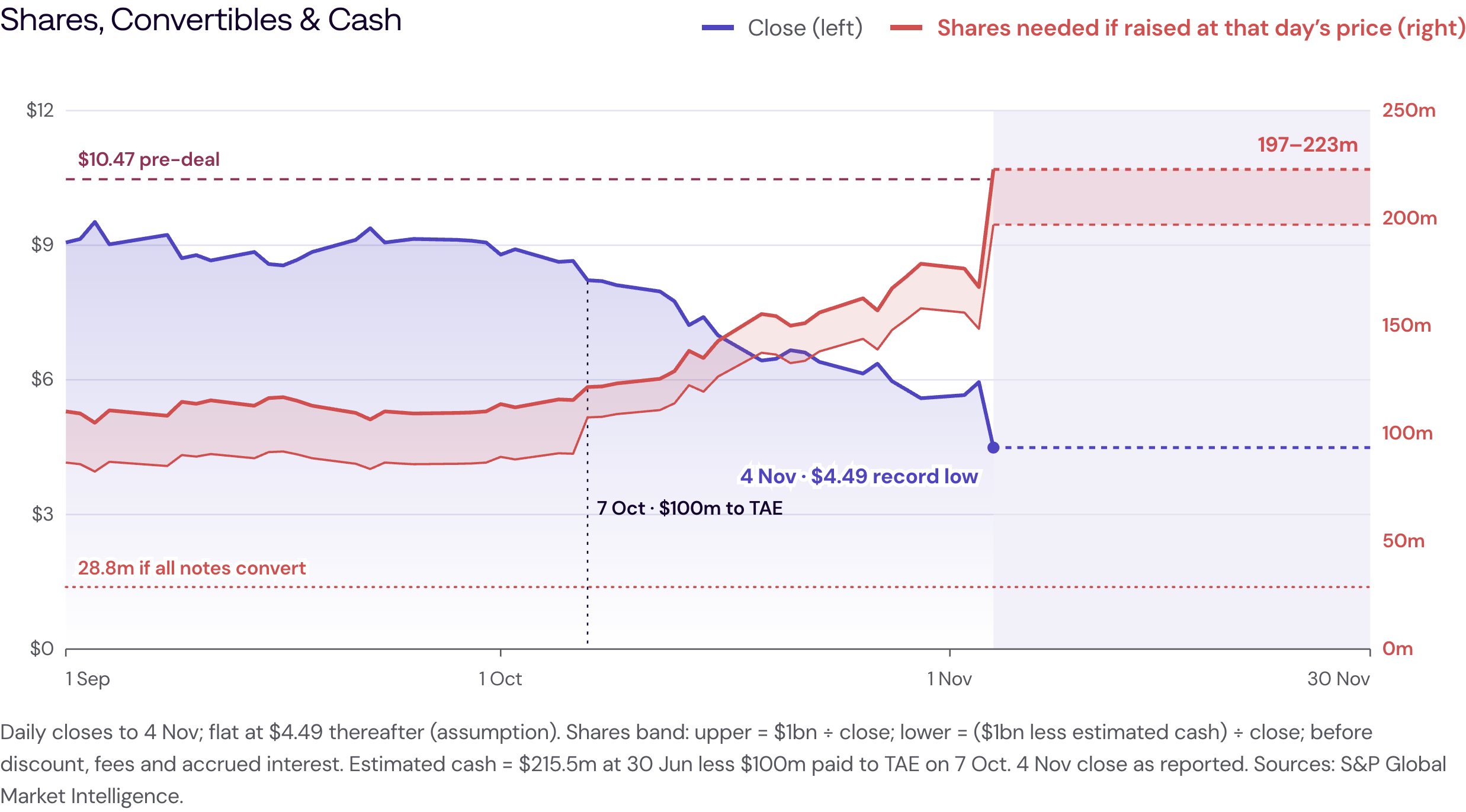
As the US turned blue, Trump Media & Technology Group (TMTG) turned ever more red. Its shares fell 24.5% on 4 November to close at $4.49, a record low, after Democrats won control of both houses of Congress. The stock had already fallen about 31% in the four weeks before the vote, from $8.63 on 5 October to $5.95 on 3 November. It is down more than 66% this year and about 57% below its close of $10.47 on 17 December 2025, the day before TMTG announced its merger with TAE Technologies.
TAE shareholders are due to receive TMTG shares at a fixed exchange ratio. The amended Form S-4 filed with the US Securities and Exchange Commission (SEC) on 2 November sets that ratio at 4.8327 TMTG shares for each TAE common share. At the 3 November close, each TAE common share represented $28.75 in TMTG stock, but by the close on 4 November, that had fallen to $21.70. Nothing in the deal protects TAE holders against a collapse in the value of the shares they receive, nor can either party end the merger solely because TMTG’s share price falls.
TMTG’s share price fall directly reduces the value of the shares TAE holders will receive. It does not, on its own, reduce TAE’s cash or operating assets. Nor would the merger ever have put the market value of those shares into TAE, whether at the original price or today’s much lower one. The bigger concern for TAE is whether its prospective parent can fund an ambitious timetable and the growing capital needs of commercialisation. Da Vinci, its first 50 MW power plant, is targeted for 2031. The recent filing is candid, as such filings must be, and warns that the power-plant work “may require more capital than is available.”
When the merger was announced at the end of 2025, the story was simple: an all-stock deal valuing the combined company at more than $6 billion. It gave TAE a public listing and a claim on TMTG’s crypto-charged balance sheet, its presidential brand and its “diamond-hands” investor base. We noted at the time that the deal also carried risks for TAE. If “TMTG stock falls, jerking downwards on news of delay or unforeseen challenges at TAE or a burst bitcoin bubble or some other issue faced by TMTG, then TAE may face a compounding capital problem.”
TMTG shares were trading at around $14 then. TMTG’s share price has since fallen and is still falling, new equity is increasingly dilutive, the brand has lost much of its shine, and a potential $1 billion note repurchase is approaching. That compounding capital problem is now a real possibility. Unpick TMTG’s S-4 here and you find that TAE’s $300 million loan ($200 million in December 2025 and the final $100 million in October) roughly matches what it spends to keep the lights on: a little more than $10 million a month in operating burn, before Da Vinci construction starts. TMTG has thus far bought time; the merger will need to deliver a lot more to fund a power plant.
Possible $1 billion cash call
Holders of TMTG convertible notes can require the company to buy back their notes for cash on 30 November. The price is the full outstanding principal plus accrued interest. If all eligible holders exercise their rights, the amended S-4 indicates a potential payment of approximately $1 billion plus interest.
The notes carry a conversion price of $34.722 per share, against TMTG’s 4 November close of $4.49. Converting now would yield shares worth just 13 cents for each dollar of principal, while exercising the 30 November repurchase right would entitle holders to their full principal in cash, plus accrued interest. Notwithstanding a few more weeks of TMTG credit risk, one might expect enthusiastic cashing-out at month-end. However, at 30 June, TMTG held $215.5 million in cash and cash equivalents, about a fifth of the potential $1 billion repayment.
TMTG also holds other financial assets, including digital assets, some pledged as security, and it says it may refinance, raise equity or sell digital assets to meet the demand. But each route has a cost. New borrowing would have to be secured on terms available to a loss-making company whose shares have reached a record low. Issuing new shares is another option, but one made materially worse by the collapse in TMTG’s share price. At $4.49, raising the full $1 billion would require issuing about 223 million shares, roughly twice as many as at September’s share price of around $9, and before any discount or fees. The dilution for existing shareholders would therefore be substantially greater. Selling digital assets would raise only what the market pays at the time, and pledged assets may not be freely available. Furthermore, those June cash figures predate TAE’s final $100 million loan draw in October.
TAE’s path forward
The companies say the merger will fund TAE’s path to commercial fusion power, including its first planned fusion power plant. If it succeeds, the returns could be enormous and $1 billion might eventually seem inconsequential. But for TAE, and fusion generally, the path to profitability is long, expensive and steepening.
TAE has drawn the full $300 million loan facility from TMTG. It requested the final $100 million on 30 September, and the funds were paid on 7 October. The company’s accounts for the three months to 30 June report recurring losses, negative operating cash flow and an accumulated deficit of about $1.8 billion. The accounts state that these conditions, together with its continuing funding needs, raise substantial doubt about its ability to continue as a going concern. Fusion is no stranger to elegant escapes from cash squeezes, but a leap from the frying pan does not guarantee clearing the fire, particularly given the heat around TMTG.
TMTG is scheduled to report its third-quarter results on 9 November. The amended S-4 lists a TMTG shareholder meeting on 14 December. TAE shareholder approval is also required. The merger agreement’s outside date is 18 December. After that, either party may end the deal in certain circumstances if it has not closed. For TAE, the steep pathway to power generation has become rockier. The question is less whether the deal can close than what financial capacity the combined company would have left to pursue TAE’s commercial ambitions if it does.
Fusion approach: Field Reversed Configuration, Magnetic Confinement
Country/Region: USA
Tags: TAE Technologies, Trump Media & Technology Group (TMTG)