
Japan’s fusion strategy poised to accelerate
31 October 2025

Japan’s new Prime Minister, Sanae Takaichi, has firmly placed fusion energy at the heart of her administration’s ambitious goal to achieve 100% energy self-sufficiency. In a policy speech to the Diet last week, Prime Minister Takaichi underscored her commitment, stating her government will “strive for the early practical adoption in society of next-generation advanced reactors and fusion energy.”
Japan’s current energy self-sufficiency rate of only 13.4%, one of the lowest among OECD countries, leaves the nation highly vulnerable to global energy market volatility and geopolitical risks. Takaichi’s administration views fusion as a long-term solution to this chronic dependency, offering the promise of a clean, safe, and near limitless energy source.
This declaration is not just political rhetoric; it is a continuation of a national strategy that aims to industrialize fusion power and establish Japan as a global fusion leader, demonstrating power generation in the 2030s. The LDP-Ishin coalition agreement between the ruling political parties explicitly commits to “accelerate development of nuclear fusion reactors,” providing further political backing for faster implementation.
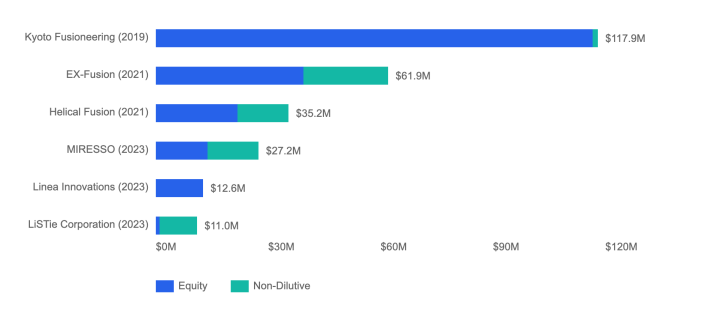 Public sector enthusiasm for fusion is mirrored in the private sector. The advance supported both by recent technical advances among private sector fusion companies in Japan and their success in raising finance. Four Japanese fusion companies – EX Fusion, Helical Fusion, Linea Innovations, MiResso – completed Series A funding rounds within a 3-month period in mid-2025 raising a total $58 million. The acceleration of development and funding timelines is equally notable, with LINEA Innovations achieving its US$12.15 million Series A in June 2025, less than two years after establishment.
FusionX spoke with Akira Tsuneto, the recently appointed Deputy Director General in Japan’s Cabinet Office, who confirmed the government’s strengthened fusion focus and noted the government maintains “significant budget” allocation for fusion activities. When asked about potential budget increases, Tsuneto said “We are trying to expand support to private companies” adding a personal commitment “to try my best to expand the budget for the fusion energy industry.” He noted too an intention to strengthen support for the Japanese fusion companies’ R&D through the SBIR program.
While the political commitment is clear, implementation details remain under development. Tsuneto confirmed the government’s roadmap for power generation demonstration will be completed by the end of fiscal year 2025, to both provide clarity on the path to the demonstration of power generation in the 2030s and to “enhance predictability to encourage more companies to enter fusion industry.” When asked on the expected structure for the delivery of the demo Tusento said “We still have not made a decision on what kind of organization will carry out the demonstration project,” noting it could yet be led by either private companies or governmental institutions.
Coinciding with this political momentum, on October 27, Helical Fusion announced the successful completion of a critical performance test of a large-scale high-temperature superconducting (HTS) coil. This test, a world-first, replicated the intense magnetic environment of a commercial fusion reactor and is a crucial step toward building a viable power plant. Helical Fusion’s CEO, Takaya Taguchi, noted that Prime Minister Takaichi had been instrumental in launching the funding initiative that supported their research when she was Minister for the Cabinet Office.
With strong political backing, centralized coordination, and advancing private sector capabilities, Japan appears poised to accelerate fusion energy ambitions significantly under Takaichi’s leadership.
………………………………………………………………………………………………………………………………………………………………………………………………………………………………………………………………………………
FusionX recently published a detailed report Japan Fusion: Innovation, Engineering & Investment examining Japan’s fusion policy and state funding; the engagement of industrial Japan; private sector fusion and its funding; the regulatory framework; and the potential role and market size of fusion in Japan.
It is currently available to download HERE.
Country/Region: Japan
Tags: EX-Fusion, Helical Fusion, LINEA Innovations, MiRESSO