
Stellarators: twists & turns on the path to commercialisation
30 July 2025
Funding surge reflects growing confidence in progress & plans
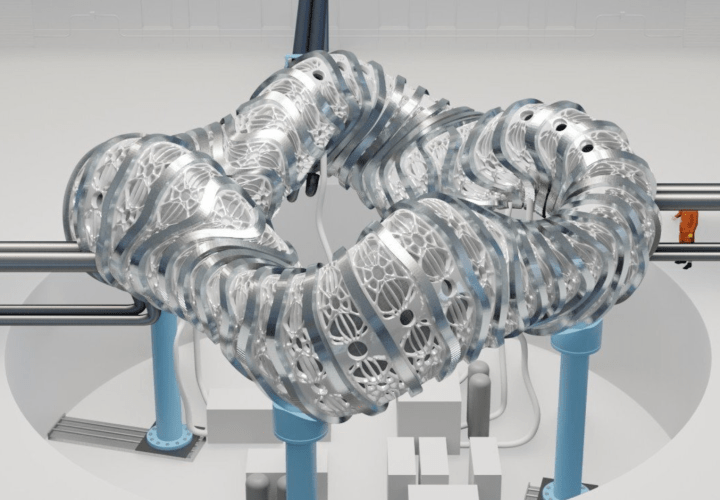
Helical Fusion‘s $15.7m Series A is the most recent in a flurry of financings for stellarators. It follows hard on the heels of Proxima Fusion‘s €130 million ($150m) Series A, the largest private fusion investment in European history that took the company’s total funding to over $200 million within two years of its incorporation. These raises combined with Renaissance Fusion′s €32 million ($35m) Series A in March this year and following strong funding support for Type One Energy’s $82.4 million seed and Thea Energy’s $20 million Series A, demonstrate sustained and growing investor interest in stellarator magnetic confinement approaches.
The stellarator concept originated at Princeton Plasma Physics Laboratory in the 1950s under Lyman Spitzer’s leadership, and represented the first serious attempt at controlled magnetic confinement fusion. While early stellarator experiments were superseded by tokamak development in the 1960s and 1970s, German research institutions maintained stellarator development through successive experimental devices, culminating in the Wendelstein 7-X facility at Max Planck Institute for Plasma Physics. The more than €1 billion investment in the Wendelstein 7-X facility has shown stellarator complexity could be managed through advanced computational design and precision manufacturing.
Stellarators require significantly more complex three-dimensional magnetic field geometries than tokamaks’ axisymmetric designs, but this complexity enables inherent steady-state operation and eliminates disruption-related risks that challenge tokamak systems. Recent advances in high-temperature superconducting magnets, computational optimization, and manufacturing precision suggest stellarator complexity is now manageable. The recent capital influx to stellarators reflects the private sector capital’s confidence in the progress being made addressing this challenge.
Stellarator designs diverge significantly in their approaches to magnetic field generation and plasma shaping. The sector’s current technical strategies can be categorized into three primary methodologies: optimization-based design building on existing experimental platforms, radical simplification through manufacturing innovation, and planar coil architectures that reduce three-dimensional complexity.
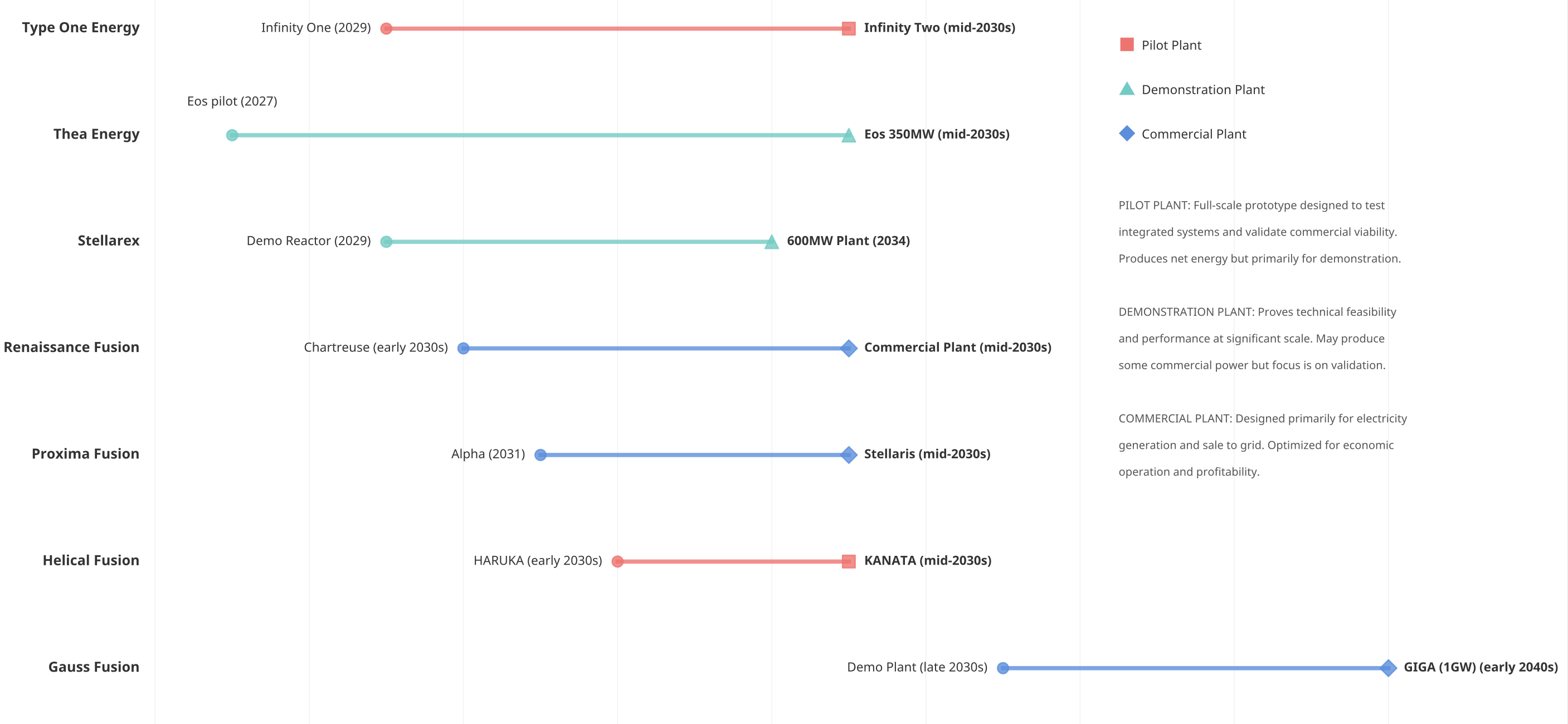
Proxima Fusion’s approach leverages the Wendelstein 7-X stellarator’s validated physics basis while incorporating high-temperature superconducting (HTS) magnet technology. The company’s technical team, including several former W7-X researchers, has developed reactor designs that maintain the proven magnetic field optimization of the German facility while addressing commercial scalability requirements. Furthermore, the company’s peer-reviewed design for their commercial fusion power plant ‘Stellaris’ incorporates materials and manufacturing processes that were unavailable during the construction of W7-X.
Renaissance Fusion has pursued a fundamentally different engineering philosophy, replacing complex three-dimensional magnet geometries with laser-etched superconducting sheets. The company’s “magnetic carpet” approach uses variable-width HTS traces to create the required magnetic field patterns, with wider traces generating stronger fields and narrower sections allowing plasma expansion. This manufacturing technique reduces the number of discrete magnet components while maintaining the magnetic field complexity necessary for plasma confinement.
Type One Energy’s technical strategy combines computational optimization with proven stellarator physics principles. The company’s design methodology draws from HSX and W7-X operational experience, applying modern computational tools to optimize magnetic field configurations for commercial power generation. Their approach emphasizes manufacturability and maintenance accessibility, addressing two primary barriers to stellarator commercialization.
Thea Energy’s planar coil architecture follows a third technical pathway, using flat superconducting coils arranged in specific geometric patterns to generate stellarator magnetic fields. This approach reduces the three-dimensional complexity of traditional stellarator magnets while maintaining the essential magnetic field characteristics required for plasma confinement.
Helical Fusion has developed a stellarator design based on decades of research from Japan’s National Institute for Fusion Science (NIFS). The company’s approach utilizes a configuration similar to the Large Helical Device (LHD), featuring two continuous helical coils that are designed to enable steady-state operation without a plasma current and incorporates proprietary HTS magnets generating 8 Tesla magnetic fields, and a flowing liquid metal wall.

From 2020 to 2025, stellarator companies completed 34 funding events, with non-dilutive grants accounting for 21 transactions and equity investments 13 transactions. Equity investments grew swiftly with pre-seed rounds in the hundreds of thousands rapidly scaling to Proxima Fusion’s $150 million Series A round.
Stellarator’s recent funding surge reflects growing confidence in progress against technical milestones and the growing potential for commercialization. The sector’s technical diversity, from optimization-based approaches to radical simplification strategies, provides multiple pathways to commercial viability, albeit with several shared challenges. Furthermore, the companies are also geographically diverse – three in the US, one in France, two in Germany, one in Japan – and can thus draw on wide spectrum of public-sector support, private sector funders, and partners in academia and industry.
 Capital deployment efficiency and excellence in operational execution will remain critical factors as companies progress from research and development, to demonstration and on to commercial phases. Risks will grow and each needs to be retired. Companies demonstrating consistent progress against technical milestones, strong talent acquisition, and partnership development will continue to attract repeat investment from existing investors and will secure further funding from the steady growth in the universe of willing capital providers. The path to commercialisation will steepen, but progress thus far suggests there will be some twists and turns at the end of it.
Fusion approach: Magnetic Confinement, Stellarator
Country/Region: EU, France, Germany, Japan, USA
Tags: Helical Fusion, Proxima Fusion, Renaissance Fusion, Thea Energy, Type One Energy