
Fusion market size
25 October 2024
Nearer term fusion construction market worth $220bn

The fusion energy revolution is closer than ever, with the potential to transform global electricity markets. By 2080, the fusion energy market for electricity generation could reach $2.1 trillion, revolutionising the global economy. Additionally, the market attributable to fusion system construction is forecasted to be a $700 billion opportunity by 2080.
Recent technological breakthroughs, most notably the National Ignition Facility (NIF) achieved scientific energy gain by producing 3.15 MJ from 2.05 MJ for the first time in any fusion experiment in 2022 and repeated this feat in July 2023. Records have also been set by the Joint European Torus (JET), the Korean Superconducting Tokamak Advanced Research (KSTAR) system, and the Tungsten Environment in Steady-state Tokamak (WEST) system.
The technological advancements go hand-in-hand with an increase in fusion energy investment by private venture capital firms and industrials, as well as renewed government commitments in key nations.

Starting in 2018 there has been a significant increase, with deal counts growing at a compound annual growth rate of 38.3%1. This surge in investment was particularly notable in 2021, driven by Commonwealth Fusion Systems securing a $1.8 billion Series B funding round and Helion Energy announcing the close of its Series E raise of $500 million in the same year.
Take-Off
The consensus is for a commercially viable ‘first of a kind’ fusion machine in the mid-2030s. The expectation from then is of rapid scaling and deployment. But the pace, direction, and location of fusion’s penetration of electricity markets, and the opportunity for the supply chain companies who will provide the components and sub-systems for those fusion power plants, for the engineering, procurement and construction (EPC) contractors who might build them, the lawyers who will advise and for the banks who will arrange the construction loans and the bond take-outs, are less clear.
FusionX collaborated with Helixos, a consultancy that specialises in fusion and nuclear energy, to develop the most rigorous and detailed market-sizing study2 to date. That study aimed to define the scale of the opportunity and to inform the strategic decision-making for makers of fusion systems, those in their supply chain and by extension all those who invest or will advise and finance the roll-out of this transformational technology.
Forecasting the growth of the global fusion electricity market to 2080 is a complex undertaking. It requires an in-depth analysis of over 190 countries across domains such as electricity market dynamics and fusion technology development. By modelling the timing and extent of aggregated country deployments, this analysis delivers a global market assessment of fusion system market penetration over the coming decades.
Analysis
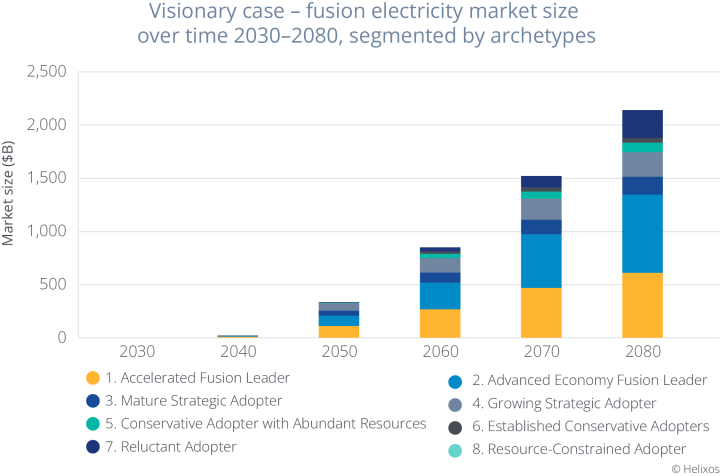
To understand when and how fast countries may deploy fusion systems, archetypes were defined to categorise countries based on factors such as their electricity needs and projected growth, their economic and political stability, their regulatory and strategic preparation, as well as the ability to develop a fusion energy industrial base. This allowed a structured analysis of each country’s ability to adopt fusion energy, including in various scenarios.
The technoeconomic analysis shows that the fusion electricity market is projected to grow to up to $2.1 trillion by 2080, with up to 13,500 fusion systems deployed globally, supplying 54% of the world’s net electricity demand.
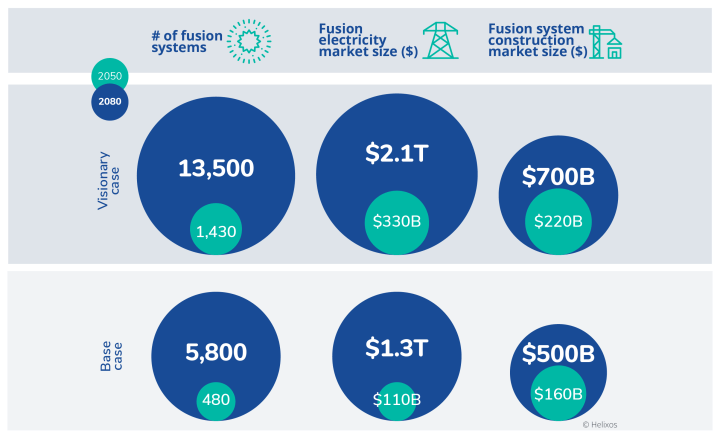
By 2040 and 2050 respectively, the electricity market size is forecasted to reach $20 billion and $330 billion, with 77 and 1,430 fusion systems in operation, as shown in the figures below. The market attributable to fusion system construction is forecasted to be a $700 billion opportunity in 2080, growing from $70 billion in 2040 and $220 billion in 2050.
Supply chain opportunity
There are significant opportunities in the fusion energy supply chain that could be leveraged immediately, such as heating and confinement systems, breeding blankets, and vacuum vessels. These components are crucial not only for the initial production of fusion systems but also for their ongoing maintenance and operation. The analysis finds that the HTS magnet subsystems alone could grow up to $190 billion per year by 2080. The report forecasts an annual spend of $700 billion by 2080 on fusion power plant construction, with accelerated growth from 2040.
1. FusionX. (2024, October 6). Retrieved from https://fusionxinvest.com/data
2. Helixos. (2024, October 9). Global Fusion Market Analysis: Electricity, Supply Chain & Construction. FusionX. Retrieved from https://fusionxinvest.com
The full FusionX/Helixos report Global Fusion Market Analysis: Electricity, Supply Chain & Construction provides specific timelines and strategic insights, with an analysis of when and where fusion systems will emerge. It aims to deliver a clear competitive edge for investors, fusion companies, and manufacturers.
Global Fusion Market Analysis: Electricity, Supply Chain & Construction is available to all FusionX Members. To become a Member and receive your copy immediately join us.
FusionX members are also entitled to a complimentary call with an expert analyst from Helixos to discuss the findings of the report. For custom in-depth analyses and assessments of fusion energy market opportunities, please contact Helixos at contact@helixos.co
